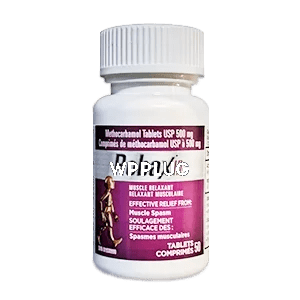
| Product dosage: 500mg | |||
|---|---|---|---|
| Package (num) | Per pill | Price | Buy |
| 10 | $4.01 | $40.10 (0%) | 🛒 Add to cart |
| 20 | $2.26 | $80.20 $45.11 (44%) | 🛒 Add to cart |
| 30 | $1.67 | $120.30 $50.13 (58%) | 🛒 Add to cart |
| 60 | $0.92 | $240.60 $55.14 (77%) | 🛒 Add to cart |
| 90 | $0.67 | $360.90 $60.15 (83%) | 🛒 Add to cart |
| 120 | $0.58 | $481.20 $70.18 (85%) | 🛒 Add to cart |
| 180 | $0.50 | $721.81 $90.23 (87%) | 🛒 Add to cart |
| 270 | $0.45 | $1082.71 $120.30 (89%) | 🛒 Add to cart |
| 360 | $0.42
Best per pill | $1443.61 $150.38 (90%) | 🛒 Add to cart |
Synonyms | |||
Robaxin: Targeted Muscle Relaxation for Acute Musculoskeletal Pain
Robaxin (methocarbamol) is a centrally acting skeletal muscle relaxant indicated for the relief of discomfort associated with acute, painful musculoskeletal conditions. It is used as an adjunct to rest, physical therapy, and other measures for the relief of muscle spasm. The medication works by depressing polysynaptic spinal reflexes and blocking the transmission of nerve impulses, thereby reducing skeletal muscle hyperactivity without directly affecting muscle contractility. It is particularly valued in clinical practice for its favorable efficacy-to-side-effect profile when used appropriately for short-term management.
Features
- Active ingredient: Methocarbamol
- Available in 500 mg and 750 mg oral tablets
- Also available in injectable form for intramuscular or intravenous use in severe cases
- Onset of action typically within 30 minutes for oral administration
- Metabolized hepatically via dealkylation and hydroxylation
- Excreted primarily renally as metabolites
- Plasma half-life of approximately 1-2 hours
Benefits
- Provides rapid relief from acute muscle spasms and associated pain
- Reduces muscle stiffness and improves range of motion
- Allows patients to participate more effectively in physical therapy
- May decrease the need for additional analgesic medications
- Helps break the cycle of pain-spasm-pain in musculoskeletal disorders
- Facilitates faster return to normal activities when used as part of comprehensive treatment
Common use
Robaxin is commonly prescribed for acute musculoskeletal conditions including back pain, muscle strains, sprains, and other traumatic injuries causing muscle spasm. It is frequently used post-operatively to manage muscle spasms following orthopedic procedures. The medication is typically employed during the acute phase of musculoskeletal disorders, usually for periods not exceeding two to three weeks, as part of a comprehensive treatment plan that may include rest, physical therapy, and other analgesics.
Dosage and direction
For adults and children 16 years and older: The initial dose is 1500 mg three times daily for the first 48-72 hours (up to 8 grams per day may be used in severe conditions). For maintenance, 1000 mg four times daily, or 1500 mg three times daily, or 2000 mg twice daily. The dosage should be gradually reduced to the lowest effective level.
For injectable form: Administer by deep intramuscular injection or slow intravenous injection (no more than 3 mL per minute). Maximum intravenous dosage should not exceed 3 grams daily.
Take with food to minimize gastrointestinal upset. Tablets should be swallowed whole with a full glass of water.
Precautions
Use with caution in patients with hepatic impairment due to hepatic metabolism. Monitor renal function in patients with pre-existing renal disease. May cause drowsiness or dizziness; patients should avoid operating machinery or driving until response is determined. Use cautiously in elderly patients who may be more sensitive to CNS effects. Avoid alcohol consumption during therapy. Not recommended for prolonged use beyond 2-3 weeks without reevaluation.
Contraindications
Hypersensitivity to methocarbamol or any component of the formulation. Patients with renal impairment (for injectable form due to polyethylene glycol content). Should not be used in patients with myasthenia gravis. Contraindicated in patients with a history of allergic or anaphylactoid reactions to methocarbamol.
Possible side effects
Common (≥1%): Dizziness, drowsiness, nausea, vomiting, headache, blurred vision. Less common: Rash, urticaria, pruritus, flushing, metallic taste, nasal congestion, fever. Rare but serious: Anaphylactic reactions, leukopenia, seizures (with intravenous administration), jaundice, syncope. Injectable form may cause pain at injection site, thrombophlebitis, or extravasation injury.
Drug interaction
May enhance effects of alcohol and other CNS depressants (benzodiazepines, opioids, sedatives). May increase risk of serotonin syndrome when used with serotonergic drugs. Cholinesterase inhibitors may antagonize effects. May interfere with laboratory tests for 5-HIAA and VMA. Use caution with drugs that affect hepatic enzymes.
Missed dose
If a dose is missed, take it as soon as remembered unless it is almost time for the next dose. Do not double the dose to make up for a missed dose. Maintain regular dosing schedule. If multiple doses are missed, contact healthcare provider for guidance on resuming therapy.
Overdose
Symptoms may include nausea, vomiting, drowsiness, blurred vision, hypotonia, coma, and respiratory depression. Management includes gastric lavage if recent ingestion, supportive care, and monitoring of vital functions. There is no specific antidote. Hemodialysis may be of limited value due to high protein binding. Seek immediate medical attention for suspected overdose.
Storage
Store at controlled room temperature (20-25°C or 68-77°F). Protect from light and moisture. Keep in original container tightly closed. Do not use if tablets show signs of discoloration or deterioration. Keep out of reach of children and pets. Do not flush medications down toilet or pour into drain.
Disclaimer
This information is for educational purposes only and does not constitute medical advice. Always consult with a qualified healthcare professional before starting or changing any medication regimen. Individual response to medication may vary. Proper diagnosis and supervision by a healthcare provider are essential for safe and effective use.
Reviews
Clinical studies demonstrate Robaxin’s efficacy in reducing muscle spasm and pain scores compared to placebo. In a randomized controlled trial of 174 patients with acute musculoskeletal spasms, methocarbamol showed significant improvement in muscle spasm, pain at rest, and pain on movement at 48 and 72 hours. Another study involving 204 patients found methocarbamol provided statistically significant relief of low back pain compared to placebo. Patient reviews generally report effective relief of muscle spasms with tolerable side effects when used as directed. Many clinicians appreciate its rapid onset and effectiveness as part of multimodal pain management.