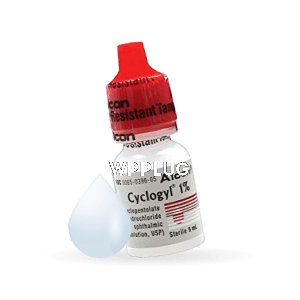
| Product dosage: 5 ml | |||
|---|---|---|---|
| Package (num) | Per bottle | Price | Buy |
| 2 | $9.08 | $18.16 (0%) | 🛒 Add to cart |
| 4 | $6.31 | $36.33 $25.23 (31%) | 🛒 Add to cart |
| 6 | $5.38
Best per bottle | $54.49 $32.29 (41%) | 🛒 Add to cart |
Synonyms | |||
Cyclogyl: Rapid Mydriasis for Precise Ophthalmic Diagnosis
Cyclogyl (cyclopentolate hydrochloride) is a potent anticholinergic agent formulated as an ophthalmic solution for diagnostic procedures. It induces rapid and effective mydriasis (pupil dilation) and cycloplegia (paralysis of accommodation) to facilitate thorough anterior and posterior segment examinations. Its fast onset and relatively short duration make it an indispensable tool for ophthalmologists, optometrists, and other eye care professionals in both clinical and surgical settings. This agent is particularly valued for its efficacy in pediatric populations and in patients with highly pigmented irides, where achieving sufficient dilation can be challenging.
Features
- Active ingredient: Cyclopentolate Hydrochloride
- Available concentrations: 0.5%, 1%, and 2% ophthalmic solutions
- Pharmacologic class: Anticholinergic (parasympatholytic)
- Mechanism of action: Competitive antagonism of muscarinic acetylcholine receptors in the iris sphincter muscle and ciliary body
- Presentation: Sterile, preserved, aqueous solution in dropper bottles
- Onset of action: Mydriasis typically begins within 30-60 minutes; cycloplegia within 25-75 minutes
- Duration of action: Varies by concentration; cycloplegia effects can last from 6 to 24 hours
Benefits
- Enables a comprehensive and unobstructed view of the lens, vitreous, and retina for accurate diagnosis of pathologies like retinal detachment, diabetic retinopathy, and macular degeneration.
- Facilitates precise refractive error measurement (retinoscopy) by paralyzing the eye’s focusing mechanism, eliminating accommodation that can skew results, especially in children and young adults.
- Provides predictable and rapid pupillary dilation, streamlining clinical workflow and improving patient throughput in busy practices.
- Offers a favorable duration profile for diagnostic procedures, typically allowing pupillary function to return to normal within 24 hours, minimizing long-term visual disruption for the patient.
- Proven efficacy across diverse patient demographics, including pediatric patients and individuals with darkly pigmented irises.
Common use
Cyclogyl is primarily indicated for diagnostic purposes in ophthalmology and optometry. Its most frequent application is to induce mydriasis prior to fundoscopic examination, allowing for a detailed assessment of the retina, optic disc, and vasculature. It is equally critical for achieving cycloplegia prior to performing retinoscopy, especially in pediatric patients or young adults where active accommodation can mask significant refractive errors such as hyperopia. It is also employed pre-operatively for cataract and other intraocular surgeries to maintain mydriasis and prevent intraoperative miosis.
Dosage and direction
Administration must be performed by a qualified eye care professional or under their direct supervision. The dosage is individualized based on the desired depth and duration of cycloplegia and the patient’s iris pigmentation.
- For funduscopic examination: Instill 1 drop of the 0.5% or 1% solution into the conjunctival sac of each eye, repeated in 5-10 minutes if necessary.
- For cycloplegic refraction: Instill 1 drop of the 1% or 2% solution into each eye, repeated in 5-10 minutes. Refraction is typically performed 30-60 minutes after the last instillation for dark irides.
- Pediatric patients: The 0.5% and 1% solutions are commonly used. For infants and children with deeply pigmented irides, the 2% solution may be necessary. A second drop may be instilled after 5 minutes.
- Technique: Instruct the patient to tilt their head back. Gently pull the lower eyelid down to form a pouch and instill the drop(s) without touching the dropper tip to any surface. Apply gentle pressure to the lacrimal sac (nasolacrimal occlusion) for 1-2 minutes after instillation to minimize systemic absorption.
Precautions
- Use with extreme caution in patients with, or predisposed to, narrow-angle glaucoma. Mydriasis may precipitate an acute angle-closure attack.
- Exercise caution in infants, children, the elderly, and patients with Down’s syndrome due to an increased risk of systemic adverse reactions.
- Advise patients that driving or operating machinery should be avoided until vision has cleared completely due to blurred vision and photophobia.
- Contains benzalkonium chloride as a preservative, which may be absorbed by soft contact lenses. Instruct patients to remove contact lenses prior to instillation and wait at least 15 minutes before reinsertion.
- Transient stinging upon instillation is common; inform the patient to expect this sensation.
Contraindications
Cyclogyl is contraindicated in patients with a known hypersensitivity to cyclopentolate hydrochloride or any component of the formulation. It should not be used in patients with untreated anatomically narrow angles or narrow-angle glaucoma, as pupillary dilation can block the outflow of aqueous humor, causing a dangerous increase in intraocular pressure.
Possible side effect
Ocular side effects are common but typically transient. Systemic absorption can lead to more serious effects.
- Ocular: Blurred vision, photophobia, burning or stinging upon instillation, conjunctival hyperemia (redness), elevated intraocular pressure.
- Systemic (more common in children and the elderly): Tachycardia, dry mouth, flushing, urinary retention, drowsiness, dizziness, headache.
- Central Nervous System (rare, but serious): Ataxia, incoherent speech, restlessness, seizures, hallucinations, and behavioral disturbances (especially in children). These require immediate medical attention.
Drug interaction
Concurrent use with other anticholinergic drugs (e.g., atropine, scopolamine, some antihistamines, tricyclic antidepressants, antipsychotics) may potentiate both ocular and systemic adverse effects. Caution is advised when Cyclogyl is used in patients taking these medications.
Missed dose
This medication is used for a single diagnostic procedure and is not intended for chronic, scheduled dosing. The concept of a “missed dose” does not apply. The instillation protocol is managed entirely by the healthcare professional during the appointment.
Overdose
Overdose is manifested as an exaggeration of systemic anticholinergic effects: severe drowsiness, hallucinations, tachycardia, hyperthermia, and seizures, particularly in children. In case of accidental ingestion or over-instillation, the following steps should be taken:
- Flush the eyes with lukewarm water or normal saline for 15 minutes.
- For accidental ingestion, seek immediate emergency medical attention. Activated charcoal may be indicated.
- Treatment is symptomatic and supportive. Physostigmine may be considered by a physician for severe, life-threatening central anticholinergic effects.
Storage
Store at controlled room temperature, 20°C to 25°C (68°F to 77°F). Protect from light. Do not freeze. Keep the bottle tightly closed when not in use. Discard any unused solution by the expiration date printed on the bottle.
Disclaimer
This information is for educational and professional reference purposes only and does not constitute medical advice. It is not exhaustive. The prescribing healthcare professional is responsible for determining the appropriateness of Cyclogyl for an individual patient, considering their specific clinical situation, contraindications, and potential risks. Always refer to the official manufacturer’s prescribing information for the most complete and updated data.
Reviews
“An essential agent in my pediatric practice. The 1% solution provides reliable cycloplegia for accurate retinoscopy in children, which is critical for preventing amblyopia. While we must be vigilant for systemic effects in smaller patients, its efficacy is unmatched for this purpose.” – Dr. Eleanor Vance, Pediatric Ophthalmologist
“The predictable onset and duration of Cyclogyl make it a workhorse for our high-volume diagnostic clinic. It allows us to efficiently dilate pupils for detailed retinal exams without disrupting the patient’s vision for an extended period. The key is proper technique and patient education on post-procedure photophobia.” – Marcus Thorne, Lead Optometrist
“In patients with dark brown irises, achieving sufficient mydriasis can be difficult. The availability of the 2% concentration of Cyclogyl is a game-changer. It consistently provides the dilation we need for a conclusive fundus examination where weaker agents fail.” – Dr. Amina Okeke, Vitreoretinal Surgeon