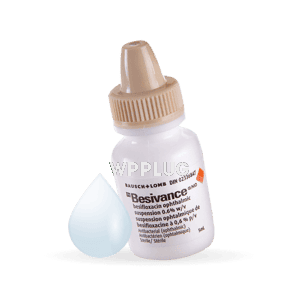
| Product dosage: 5 ml | |||
|---|---|---|---|
| Package (num) | Per flacon | Price | Buy |
| 2 | $22.60 | $45.20 (0%) | 🛒 Add to cart |
| 3 | $19.76 | $67.81 $59.27 (13%) | 🛒 Add to cart |
| 4 | $19.34 | $90.41 $77.35 (14%) | 🛒 Add to cart |
| 5 | $17.68
Best per flacon | $113.01 $88.40 (22%) | 🛒 Add to cart |
Synonyms | |||
Besivance Ophthalmic Solution: Advanced Bacterial Conjunctivitis Treatment
Besivance (besifloxacin ophthalmic suspension) 0.6% is a next-generation fluoroquinolone antibacterial indicated for the treatment of bacterial conjunctivitis. Formulated as a sterile ophthalmic suspension, it is designed to target a broad spectrum of ocular pathogens with high efficacy and a favorable safety profile. Its unique viscous formulation enhances corneal residence time, ensuring sustained antimicrobial activity at the site of infection. This product is intended for topical ophthalmic use only and should be administered under the guidance of a healthcare professional.
Features
- Contains besifloxacin hydrochloride equivalent to 0.6% besifloxacin
- Sterile, preserved, isotonic ophthalmic suspension
- Formulated with DuraSite® technology for prolonged ocular surface retention
- Effective against a wide range of Gram-positive and Gram-negative bacteria
- Convenient dosing: supplied in a 5 mL bottle with controlled dropper tip
Benefits
- Rapid bactericidal action against common ocular pathogens, including resistant strains
- Enhanced bioavailability and prolonged contact time due to mucoadhesive polymer base
- Low potential for developing bacterial resistance compared to earlier-generation antibiotics
- Reduces signs and symptoms of bacterial conjunctivitis, such as purulent discharge and conjunctival injection
- Well-tolerated with a low incidence of adverse effects in clinical studies
- Convenient twice-daily dosing regimen supports patient adherence
Common use
Besivance is primarily prescribed for the treatment of bacterial conjunctivitis caused by susceptible isolates of CDC coryneform group G, Corynebacterium pseudodiphtheriticum, Corynebacterium striatum, Haemophilus influenzae, Moraxella lacunata, Staphylococcus aureus, Staphylococcus epidermidis, Staphylococcus hominis, Staphylococcus lugdunensis, Streptococcus mitis group, Streptococcus oralis, Strengococcus pneumoniae, and Streptococcus salivarius. It is not effective against viral or fungal conjunctivitis and should only be used when bacterial infection is confirmed or strongly suspected.
Dosage and direction
Instill one drop into the affected eye(s) twice daily, approximately 8 to 12 hours apart, for 7 days. Continue treatment for the full prescribed duration even if symptoms improve earlier. To administer: wash hands thoroughly before use. Avoid touching the dropper tip to any surface to prevent contamination. Tilt head back, pull down lower eyelid to create a small pocket, and instill one drop. Close eyes gently for 1–2 minutes and apply gentle pressure to the lacrimal sac to minimize systemic absorption. If using other ophthalmic products, administer at least 5 minutes apart.
Precautions
- For topical ophthalmic use only. Not for injection or oral use.
- Contact lenses should not be worn during treatment for bacterial conjunctivitis.
- Prolonged use may result in overgrowth of non-susceptible organisms, including fungi.
- Patients should be advised not to wear contact lenses if they have signs and symptoms of bacterial conjunctivitis.
- If symptoms persist or worsen after 7 days of treatment, reevaluate the patient.
- Use with caution in patients with a history of hypersensitivity to fluoroquinolones.
- Systemic quinolones have been associated with serious adverse reactions; however, systemic exposure to besifloxacin following topical administration is minimal.
Contraindications
Besivance is contraindicated in patients with a history of hypersensitivity to besifloxacin, other quinolones, or any component of this formulation. Cross-sensitivity to other quinolones may occur; discontinue use immediately at the first sign of allergic reaction.
Possible side effects
The most common ocular adverse reactions reported in 1–5% of patients included blurred vision, eye pain, eye irritation, eye pruritus, and conjunctival redness. Other less common reactions (<1%) included dry eye, eye discharge, headache, altered taste sensation, and nasopharyngitis. Serious adverse reactions are rare but may include severe allergic reactions characterized by eyelid edema, chemosis, and corneal infiltrates. Patients should be advised to discontinue use and consult their physician if any severe reaction occurs.
Drug interaction
Formal drug interaction studies have not been conducted with Besivance. However, due to minimal systemic absorption following topical ocular administration, interactions with systemically administered drugs are unlikely. When multiple topical ophthalmic medications are used, administer at least 5 minutes apart to prevent washout and ensure adequate absorption.
Missed dose
If a dose is missed, administer it as soon as possible. However, if it is almost time for the next dose, skip the missed dose and resume the regular dosing schedule. Do not double the dose to make up for a missed one.
Overdose
Topical ocular overdose is unlikely to cause significant systemic effects due to minimal absorption. If accidentally ingested, symptomatic and supportive care is recommended. Ocular overdose may be flushed with warm water. In case of suspected overdose, contact a poison control center or healthcare provider.
Storage
Store at 2°C to 25°C (36°F to 77°F). Do not freeze. Keep the bottle tightly closed when not in use. Discard the bottle 14 days after opening to prevent contamination. Keep out of reach of children and pets.
Disclaimer
This information is provided for educational purposes only and does not replace professional medical advice. Always consult a qualified healthcare provider for diagnosis and treatment recommendations. The prescribing physician should be aware of the complete prescribing information before initiating therapy.
Reviews
Clinical studies demonstrate that Besivance achieves clinical resolution in approximately 85–90% of bacterial conjunctivitis cases by day 5–8 of treatment. Patients report significant improvement in redness, discharge, and discomfort within 48–72 hours of initiation. Ophthalmologists appreciate its broad-spectrum coverage, low resistance potential, and convenient dosing schedule. Some patients note transient blurred vision following installation, but this typically resolves within minutes. Overall, it is considered an effective first-line treatment for bacterial conjunctivitis in both adults and pediatric patients (1 year and older).